Sunday, July 15, 2012

How Much of My Donation Is Spent On Overheads (Or Why Admin Costs Are Bull***t)

How much of my donation is spent/wasted on admin/wages/overheads?


First of all I'll answer your question, and then I'll tell you why you're asking the wrong question.

For the sake of convenience I'll use the word admin to cover all wages, overheads...all that boring stuff that nobody likes to fund.

The amount of your donation that goes on admin depends on the organisation. It's usually on their website or available if you ask and it's usually about 10% or maybe 15%-20%. Some organisations will tell you 100% of your donation goes to 'the cause' and none goes on admin. What they do here is secure funding elsewhere, make out like that covers the boring stuff, and then make this pointless claim to you. Every charity has overheads. All money received is income and everything they spend on is expenditure. It's futile to say that the 20 Euro note you just gave is going to go here or there. It goes in to a bank account with all the other money.

And these figures, these percentages, are meaningless. What is admin? Whose wages are admin and whose are the cause?

The doctor performing surgery to give people their sight back...that's the cause, right? Or is it admin and wages? The person who co-ordinates these surgeries, schedules them and makes them happen...that's pure admin, right? But the cause wouldn't happen if this person didn't arrange it, so let's file it elsewhere.

The cost of transport - essential to making things happen - admin or cause? When the water charges come in...what do you want hospices to classify these as? Nurses need to wash their hands, people need to drink water. Cause or admin?

Amnesty International does the amazing work it does by raising awareness, campaigning, sending letters. Lots of printing. Lots of photocopying. It's probably all admin. But it's also probably all the cause.

All these charities have different definitions and they dress up their figures differently, fuelled by the public's demand to hear a percentage that they can judge their work by. It's meaningless and it's lazy. 100% of your donation goes to the cause every time. Whether it's spent on rehydration packs, surgery, wages, advertising or fundraising it is all the cause.

So can we stop asking it? And can charities either stop providing it or, when they do, issue a massive disclaimer on why admin costs are bullshit and start educating people on what question they should be asking.

You should be asking, "What will my donation do?"

Imagine two charities, both of which give people their sight back. One has 10% admin and one has 20% admin. Which do you donate to?

Well what if I told you the second one spends that extra admin on better doctors, which allows them to cure the blindness of more people each year. They spend more money on recruitment which allows a better calibre of staff - less quacks and less botched surgeries. Which do you donate to?

Instead of asking how much of my donation goes where, what about what is this organisation going to do? How many lives are you going to save?

I don't care how Apple or Google or Pepsi spend my money as long as I get a fantastic end product that meets or exceeds my expectations. I demand the same from my charities.

So let's change it.

If you're a charity let's start by educating the public and standing up for yourself in the media.

If you're a donor be proud of funding the wages, the admin, the overheads. They're part of the package.

To all the charities I donate to: I believe in you. I want you to spend my donation on your wages, on your toilet paper, the spatula on the new Rainbow Warrior, on your Xmas party. Whatever you feel it takes to change the world. I trust you. I know you will run your organisation to the best of your ability. Just keep me updated, and hopefully you won't have to waste any more time justifying yourself to the press and the rest of the people that don't trust you anyway.

Wednesday, July 4, 2012

What I Learned At The IOFNC 2012

Just unwinding after the Institute of Fundraising National Convention and I decided to key some notes up on my public blog so that not only will I always have them available, but so that you - if you were unable to attend - can get something from the IOFNC.
Why not read these while pretending you're at a conference? Why not write your name on a piece of paper and attach it to a lanyard around your neck? Say the word 'lanyard' out loud, and then lose that piece of paper briefly. Why not drink some really shitty tea and put a bunch of business cards in all of your pockets? Just start talking to a stranger. Network with your cat. Don't go outside for three days. Forget about your real life.

There were lots of iPads floating about this year and this was the first year I took notes on my mobile rather than pen and paper. Sometimes I drift in to a special place where I write down stuff that has nothing to do with what the speaker is saying.  So here we go...some of it may be nonsense...stream of consciousness...

Start Qualifying Everything
Every cost - how many donors is it worth? You're spending €150 on attending a conference? That's this month's donation from ten donors...make it worth it.
On the flip side, every fundraising campaign - what will it do? This month's door-to-door recruitment will give sight back to 750 people around the world.

Sort out Mobile
Need to speed up the accessibility of mobile giving in Ireland. JustGiving doubled conversion rates by adding a mobile donation site.
ourmobileplanet.com
SMS 'Skip' instead of 'Stop' - UNICEF using successfully.
Send an SMS ask to cancelled DDs.

"Your Board of Directors will not approve"
True words from the one-and-only AJ Leon.
Irish boards are holding back Irish charities.
trendwatching.com

"Why aren't we protecting voice?"
A beautiful, beautiful (possibly paraphrased) quote from Adrian Salmon.
Telephone fundraising and face-to-face fundraising are so, so powerful. There will always be a place for them and anyone who is investing in on-line and digital before they are investing in telephone is crazy. Ireland is full of that negligence. I can't believe how slow the uptake in telephone fundraising is in Ireland.
It works. Ask me how. (www.totalfundraising.ie)

On-line/Off-line Preference
People don't know what they want...stop asking them.
Prostate cancer mailing - the guy who said mail is dead and then goes on to fall in love with a talking walnut that got posted to him.

Updates to Staff
Weekly charity highlight, videos, messages from donors and staff and more.


It was an amazing Institute of Fundraising National Convention. As always, it was brilliant and I think I saw the best session I have ever seen at any conference. (Interestingly, I also think I saw the worst session I have ever seen). Thank you to everyone involved. (Except the worst session people).

Thursday, June 14, 2012

Top-Level Domains - What Do They Mean For The Charity Sector?

A top-level domain is the last part of a web address, eg. .com or .org. These are generic ones that any organisation or individual can register. You also have country specific TLDs, such as .ie and .co.uk. And then you have a handful of other sponsored TLDs that represent a specific community, such as .mil for the U.S. military and .xxx for porn sites.

ICANN (the organisation that assigns these domains) recently opened applications for any TLDs and this week they released the list of first-wave applicants they have received. They included things like .google and .youtube from you-know-who, .catholic from the Vatican, and a bunch of people applying for common words like .home and .music.

Domain names have become like land and, because they are finite, are becoming more and more difficult to get your hands on. There are no 3-letter .com addresses available anymore. Any of you that have tried to register a domain for a specific campaign have probably found it's taken. By opening up these TLDs you are essentially creating more 'land' and it's potentially a massive money spinner. I don't know enough about it to say whether it's a good or bad thing, but at first glance it reminds me of the Celtic Tiger when everyone started building and buying apartments. That worked out fine, didn't it?

It wasn't cheap to apply, with the initial application alone costing applicants US$185,000, which is probably the main reason why there was no application
for .oxfam and .amnesty, and why I decided against applying for any.

But there are a number of applications in there that are related to or may have an impact on the charity sector and I think these are worth looking at:

.charity
A private U.S. company named Donuts applied for this. Under various names they also applied for .fund, .gifts and around 300 other TLDs. Donuts are essentially a re-seller and, if they successfully register .charity then you will need to go through them to secure your new web address of www.oxfam.charity or www.concern.charity.
Donuts "
intends to increase competition and consumer choice at the top level". In their own words, "The .CHARITY TLD will be of interest to the millions of persons and organizations worldwide involved in philanthropy, humanitarian outreach, and the benevolent care of those in need. This broad and diverse set includes organizations that collect and distribute funds and materials for charities, provide for individuals and groups with medical or other special needs, and raise awareness for issues and conditions that would benefit from additional resources. In addition, the term CHARITY, which connotes kindness toward others, is a means for expression for those devoted to compassion and good will. We would operate the .CHARITY TLD in the best interest of registrants who use the TLD in varied ways, and in a legitimate and secure manner."
But interestingly, on the application where it asks, "Is the application for a community-based TLD?" Donuts said 'No'.
Famous Four Media also applied for .charity and it is now up to ICANN to decide which company (if any) gets it. .ngo
The Public Internet Registry (the people that administer .org domains) applied for this. They are a not-for-profit corporation and this instills confidence in me. Maybe I'm being naive.
.heart
The American Heart Association applied for this TLD. I find this incredible that a charitable organisation can justify the hundreds of thousands of dollars it will cost to secure and maintain. I can not see any marketing benefit - people will still Google them. Their existing domain is www.heart.org. Do they really need .heart?

The only justifiable reason I can think of is as a fundraiser. If the AHA intends to re-sell .heart domains and they think they can make money from it then great.

.cancerresearch
Australian Cancer Research Foundation applied for this. Again, I don't see the point but I hope they'll show me.

The only thing I would say about this is why would you apply for .cancerresearch rather than .cancer? Nobody applied for .cancer. It seems like .cancer would be a far more awesome TLD to own.

.giving
JustGiving applied for .giving. Now I think JustGiving are incredible and rarely, if ever, put a foot wrong...but why do they need .giving? Is the cost justifiable?

My gut feeling is that this will be an add-on service for charities - charities will pay to secure the web address of oxfam.giving or barnardos.giving for their fundraising pages. By charging for this it might be worth it.

Presumably they would also look at giving fundraisers their own domain names. e.g. I could get simonscriver.giving (perhaps for a price?), but I just don't feel that's worthwhile. My own personal feeling is that people donate through these on-line portals via a link or a search from the homepage. They don't type in www.sponsor.ie/siscri - they either click that link or go to www.sponsor.ie and search for me.

Or perhaps they're looking to bring their international sites to one space. But wouldn't their existing justgiving.com be the logical place to do this?

I'm really interested to see what they're going to do with this if their application is successful.

Missing Domains
Nobody applied for .give, .sponsor or .donate.

So...
These applications will be processed over the next year with interested parties invited to contact ICANN with their thoughts.

From a charity point of view we have to hope that an influx of possible domains will drive down the cost of registering new sites. But if you're a charity and you're reading this I'm willing to bet you already have a domain name that you've been working on publicising and you're not about to go and change your main website.

Where it will come in handy is for micro-sites - dedicated sites for specific campaigns. Suddenly there will be a lot more choice for you.

So what does the opening of Top-Level Domains mean for the charity sector?

Not much.

Tuesday, May 22, 2012

Why We're Switching to iPads

What you might notice over the coming weeks and months on the street, at your door step and in shopping centres are more and more fundraisers carrying iPads. We are moving away from paper Direct Debit forms and, in stages, kitting out every one of our chuggers with a brand spanking new iPad.

Now presumably it's only a matter of time before someone with a platform vocalises their objections to this 'waste of charity money' and so I thought it would be a good idea to explain the thinking behind this move in advance so as to reduce these opinion pieces and so that we can all mock anyone that makes this claim, knowing that they haven't done their research and they certainly haven't asked us why we switched.

We would not be doing this unless it made financial sense to Total Fundraising and to the charities we represent.

There are many, many advantages to using iPads and electronic sign-ups over paper sign-ups. These include:

Cost
While there is an up-front cost (huge up-front cost) in purchasing 80+ iPads and developing the sign-up and back-end software, there are long-term savings made to both Total Fundraising and the charities involved (just to be clear the iPad campaigns aren't going to cost charities anything extra - it will only save them money).

  • Most obviously, we no longer need to pay to print triplicate carbon copy mandate forms, a number of which are cancelled, voided and 'soiled' during each campaign. These cost us about €1 per mandate and when signing up 30-50,000 mandates a year this is a substantial saving.
  • We save on printing and laminating the 'presenters' that our fundraisers carry, as well as the A4 folders themselves. Instead, the photos and statistics our chuggers refer to are now displayed on the iPads themselves.
  • We save on postage. With postage costs rising it is especially pleasing to eliminate the registered posts costs that our roaming teams incur every day.
  • We no longer have to pay a staff member to log these paper batches, to key the donor data and to key the hours and results for wages. It will reduce the workload for our payroll staff, our Donor Care staff (welcome callers) and our data entry staff. Fortunately, the increase in size of the business is compensating for this so we don't need to downsize our workforce.

Quality
  • About 12% of the account numbers we receive from new donors are invalid. We validate all account numbers when they reach the office to ensure that we do not provide any invalid accounts to our charity partners and they do not waste any time or money presenting them for direct debit.
    When we discover these 12% of invalids in our offices we then have to put the time and money in to contacting the donor to correct the details. Very often the donors are not contactable.
    By validating the details at the time of sign-up through the iPad we eliminate these invalid accounts. It gives the potential donor the opportunity to doublecheck their account details or to change their mind, and we no longer need to process.
  • The iPads also improve our data capture - we can ensure e-mail addresses and telephone numbers are captured and are captured in the correct format. Fundraisers are prompted to ask for contact preferences and other details that they may have otherwise forgotten about. We can quickly and easily make certain fields compulsory. And we can put automated restrictions on certain donors, such as minimum age limits.

Security
  • We take a huge amount of care with the transport and storage of our paper mandates. Nevertheless, in terms of security it's not ideal. The iPads allow new donor details to be securely sent and stored electronically, instantly, and no personal data is stored on the iPads. If an iPad is lost or stolen there is no issue with data security.
  • Another interesting point to note is that if an iPad does get stolen or lost we can track it through GPS and determine exactly where it is. We can also remotely lock it and remotely wipe it. Very cool.

Control
  • Tracking where the iPad is in real-time is just one level of control this new technology gives us. We can also track sign-ups in real-time and track quality in real-time.
  • We can feed information to the iPad immediately. We can update information and forms on the iPad remotely. For example, if a charity releases new stats today we can update the fundraisers presenters immediately. If we find that not enough e-mail addresses are being captured we can remotely make it a compulsory field, or highlight it so it's not being overlooked.

Motivation

  • One of my favourite things about the iPads is that the fundraisers and managers can see their stats in real-time. They can see the average age of the donors they sign up, the average gift, how much they have generated for charity between all their donors, and much more. They can see how they compare with their co-workers. This is a highly motivational tool.

Technological Innovation

  • The iPads are going to allow us to do some really awesome stuff: with the donors' permission we can capture photos and video, we can use the GPS to do some cool location stuff, we can link in to websites and social media to update live. There are a lot of possibilities and we plan on exploring all of these with the innovative charities that we work with...

This is going to be really cool. Feel free to chat to the fundraisers to see how it works. While you're at it, why don't you sign up and make the world a better place?

Tuesday, May 15, 2012

National Volunteering Week

It's National Volunteering Week, which is great. Volunteering is a beautiful thing where everyone benefits.

But did you ever stop to consider that it might be more productive to use those volunteering hours to instead work extra hours in a paid job that you're qualified in, excel in, and probably already work in?

You might not feel as if that's as worthwhile, but you could then take the money you earn from those extra hours and donate them to a cause or a charity you believe in.

With this income the charity could hire someone to do the work you were about to volunteer to do. Realistically, for the amount you've donated, they could probably hire someone to do more hours then you were going to give. They can probably get someone that's better at it than you are. Someone who's qualified. Someone who is going to turn up reliably because, let's face it, you were probably going to flake out after a couple of weeks. Instead they can hire someone who needs the work. You'd be lifting someone out of unemployment. You'd be helping our economy.

It doesn't feel as warm and fuzzy, does it? But economically and financially it probably makes sense.

You should feel good about that. And you should get back to work.

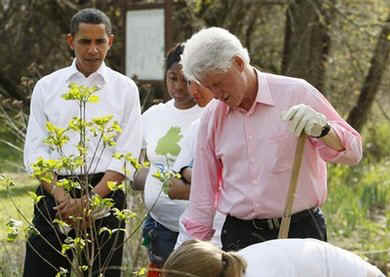
Here's Bill Clinton planting a tree as a volunteer:


But Bill Clinton earns around $181,000 for a paid speaking engagement. Instead of using this time to plant a tree would he have been better off using the time to speak and donating that money to employ some professional gardeners? $181,000 would get you about 18,100 hours of gardening time if you're paying 10 bucks an hour. You could get 10 people in to full-time employment for a year for that.

Of course, I'm just being facetious. I get it that there is a lot more to it than that. It's about what you gain from the experience as a volunteer. It's about donating your own unique skills. It's about making amazing connections you wouldn't normally make. And I genuinely believe we can make a difference by volunteering. Check out http://www.volunteer.ie/ to find an opportunity now.

Friday, May 11, 2012

Non-profit, non-sense

I made a ridiculous statement in a meeting this week where I claimed there was no such thing as a non-profit organisation. More specifically, profit making companies and non-profits are essentially the same thing but just perceived differently.

Yes, it doesn't really make sense and is easily disputed and dismissed. Legally there are non-profits. But I think where my statement stemmed from was a frustration in the assumption that non-profits are good and profit making is bad.

More than that, I think I can trace the seed of this thought back to statements two different charity employees made recently.

The first one was earlier this year when a charity employee said he disagreed with fundraising agencies, as opposed to in-house, because they were 'commercial'.

I don't see the difference. He cares about the cause he fundraises for, I care about the causes I fundraise for. He gets paid, I get paid. How am I any more commercial? Being a longterm employee in a fantastic role there is every chance he earns more than me.

The second statement was from a charity employee who used to work for an agency. He criticised agencies for making their shareholders rich. This is from someone who earns bonuses from his charity employer for hitting fundraising targets.

I get bonuses too. They're called dividends. When my company hits targets and makes profit I get this bonus. I didn't receive any bonus this year because we put all our profits back in to the company to develop two new fundraising products.

So how different are agency fundraisers and in-house fundraisers?

And what does this have to do with the term 'non-profit'?

Well I could run a charity, pay myself whatever I want - even millions - and still be commended for being a not-for-profit.

Alternatively I could run my business, pay myself nothing, but take a tiny shareholder dividend if I have a really good year. I'd be a profit making company.

This is not the way to measure effectiveness.

The truth is every organisation, both profit making and not-for-profit, is somewhere inbetween these two extreme examples. Financial reports are dressed up to appear the way organisations want to be perceived. And these shed very little light on how effective an organisation is in changing the world.

Wednesday, May 2, 2012

How We Can Make The Irish Charities Expo Work

I nearly called this post "Why The Irish Charities Expo Sucked". But that would be harsh, wouldn't it? And so negative. The truth is there were a lot of positives about today's first ever Irish Charities Expo: the charity turnout was good with a lot of effort put in, some fantastic speakers for free, and [initially] a really lovely, positive vibe.

It was especially good for us as a supplier as we got to talk to the charities about our free services Sponsor.ie and GiftCall.

But alot sucked: It seemed to have an identity crisis...who was this targeted at? It was expensive for exhibitors and the footfall of visitors was virtually zero. The general consensus was disappointment, and even  some anger.

Charities found themselves paying to exhibit because everyone was afraid it would be a huge success and they would be missing out on easy money. The Expo had said that 5,000 company representatives were invited...it might have been amazing. It wasn't. It was sad - for some charities they had paid a huge chunk of budget on this and put a lot of time and effort in to it, and it didn't pay off.

So what went wrong? A few things:

No Corporates
5,000 company representatives didn't appear. A couple of charities said they counted 4 company representatives. Not 4,000. Just 4.

And why would they come? Why would they subject themselves to a room full of charities asking them for money? Why would they throw themselves to the lions?

A company making the decision to donate to charity is relatively easy. They can do it from their office. They can respond to charities they want to respond to. They can meet who they want to meet. They can support who they want to support.

No Public
Similarly, the public wouldn't want to expose themselves to what someone described as "a room full of chuggers", but not to the same extent as the corporates. People love charities. And I really believe that a good chunk of the public would be interested in seeing all of these charities in one place, learning what they've been doing, hearing the excellent speakers, discussing volunteering opportunities, showing their support, and yes even donating to them.

But the public didn't show. Why? Probably because it wasn't marketed very well.

There was very little advertising, very little PR. Social media was not harnessed (the only Facebook presence was an event page that I set up a few days ago). Twitter was used incorrectly. Nobody knew about it.

And that's not necessarily just the Expo's fault - maybe charities didn't advertise it enough, maybe us exhibitors didn't push it enough.

Costs
The cost of exhibiting excluded a lot of charities. And almost certainly it was never going to be worthwhile. It needed to be cheap...or free...for charities. Easier said than done. But perhaps us profit-making exhibitors should have paid more. Or maybe the public (if there were any) needed to make a 'suggested contribution' on entry that was divided among all the charities involved. Or maybe they needed more sponsors. They didn't approach us for sponsorship (That always amazes me! Like the ICTR Tax Back Campaign - they are struggling for funding and they've never asked us to sponsor!)

The Charities
Maybe the charities could have done more? I spoke to a really nice print agency guy that I see from time to time. He was doing the rounds at the conference and pitching for business. He spoke to almost every charity there and then he spoke to me, at which point I asked if his company would make a donation to one of our charity partners. He said I was the first person there to ask him for money.

So What Is The Solution?
I believe this can work. I want this to work. I think it's a beautiful idea and can be a great thing for the charities, the corporates, and the general public. So how do we make it work?

Well, it needs to be better advertised. It needs an attraction: a celebrity, an amazing keynote speaker, free shit.

It needs to be cheap, or free, for charities. More of them will exhibit (perhaps with smaller stands) and this will allow the organisers to get more company exhibitors to pay. Make companies like mine pay double, half of which sponsors a charity of our choice to attend and exhibit.

It needs to be better integrated with the charity sector. What about partnering with Fundraising Ireland and running in conjunction with their annual conference. Day 1 is the annual fundraising conference, Day 2 is open to the public with the charities exhibiting and speaking. Maybe at a more appropriate venue.

But I'm writing this on the day of the conference. Let me sleep on it. Maybe I'm being too critical. It's easy to criticise. Maybe there's a lot more to it. We all want this to work, and I hope this will be read as constructive criticism.

On a final note, the other thing that pissed me off was one of the organisers walked by me a few times and blanked me when I smiled, nodded or said hello. I paid for four stands at this thing and the guy wouldn't even acknowledge me.