In the last week a few people on my Twitter timeline have posted (some sceptically) the results of Google's research in to how and why people donate on-line.
The conclusions from the statistics included that 75% of people start their donation research on-line, 74% of people donate because they believe in the mission, and 57% of people make a donation after watching a video.
I'm going to go out on a limb here and say that this is all complete bullshit.
Firstly, common sense - think about those numbers. Of course it's not true that more than half of people donate after watching a video. Of course it's not true that three quarters of people donate because they believe in the mission - do you even know what your favourite charity's mission is?
Secondly, let's look at the survey and trace it back.
The article I just read was this one, that exclaims that "57% of Those Who Watch Nonprofit Videos Go On to Make a Donation". Please note that the article is written by a YouTube Video Producer. I'm sure he's very good at that. But his statistic is just not true. That's not his fault...let's look where he gets it from.
He gets it from here. It's a nice article that most subsequent articles are referring to. It casually mentions that "An impressive 57% of people who watch a video for a nonprofit go on to make a donation."
But it doesn't link to the original research, which is a shame.
The original research is quite hard to find. Here it is. It is incredibly vague and unhelpful. It's also notable in the fact that the research was actually carried out by MillwardBrown Digital...in association with Google.
Look a bit further and you'll find the methodology, which is almost always overlooked when we read statistics. This particular methodology really tells us very little.
But it does tell us they surveyed 982 people. I hate surveys - they are generally used by students and people trying to sell you something. The truth is when you ask people about their donation habits it is completely unreliable.
They also 'tracked donors behaviour backwards'. It is possible that they looked at donors, worked backwards and found that 57% of people had come from videos. But that certainly isn't the same thing as 57% of people make a donation after watching a video. I would assume that more than 99% of people watch a video and then do nothing. This is either really badly worded...or they're just wrong.
And the carelessness in this analysing and presentation of statistics is dangerous. I find statistics in charitable fundraising particularly dangerous.
Small, medium and even large charities are going to read these statistics and going to read articles written by very intelligent people. They're going to assume that it's correct - 57% of people who watch a video will go on to donate. And then they're going to put their fundraising budget in to making these videos. They'll put them on-line and they will do nothing. They will not generate income. They will fail. And that money will be gone.
These statistics are dangerous because it draws charities in to the belief that this is what will work for them.
It won't.
Please don't put your fundraising budget in to YouTube videos unless it is part of a bigger and more researched fundraising mix.
Wednesday, August 28, 2013

Monday, August 26, 2013
I Wish I'd Thought Of That: Direct Dialogue Fundraising
This is an expanded version of what I said at Fundraising Ireland's 'I Wish I'd Thought Of That' event in August 2013.
I want to talk about my favourite form of fundraising - direct dialogue, face-to-face, door-to-door, street, 'chugging'. You’ve no doubt already made your mind up about it - you use it and love it, you think it’s a necessary evil, or you hate it and you’re never going to use it.
But, I want to talk about how it changed fundraising, how it changed my life, and why I think it’s important to you whether you use it or not.
Door-to-door sales was invented shortly after the invention of door but it was around the early 70s that a charity first made a measured effort to recruit regular givers - it was the Red Cross using an agency in Germany, made up of mainly Austrian students.
And through that the concept spread back to Austria. One of the big charities to do it in Austria was Greenpeace, and one day in the hot summer of 1995 the employees of an agency named Dialog Direct were whining that there was nobody home. So they went and stood outside a public swimming pool and started talking to strangers walking by, signing them up for DD. It worked - they did it at a second swimming pool - and then shifted almost all of their door on to street.
In ‘96 the French were well into their nuclear testing - identifying some of the most beautiful places in the world and then blowing those places up - and it was thanks to this that Greenpeace really found their groove with direct recruitment.
They recruited 55,000 new direct debit donors that year through direct dialogue in Austria (a country about double our population). Some of the fundraisers involved presented it at the IFC conference - and people didn’t believe it worked. It wouldn’t work. It’s not possible. But they were wrong.
The idea was exported to Italy. Czech republic. Anywhere that could process standing orders or direct debits. Australia started using it. A telephone agency in the UK was essentially forced by Greenpeace to move out onto the street. But they knew it would be controversial, so they got the likes of Amnesty and WWF on board to help control the public opinion.
2002 or 2003-ish was about the time that the first in-house teams started to appear and about the time it arrived in Ireland.
Which brings me to 2004 - the year I started on the street for UNHCR, MSF and Forgotten Children (an Australian charity whose celebrity patron is Toadfish from Neighbours). And that changed my life.
It changed it immediately because I met amazing people, and was given amazing things on the street, and randomers would invite me to parties. I completely fell in love with the girl who trained me in and that was a disaster for about a year, and then it was really good for about 6 hours, and then it was a disaster again.
And then long-term it changed my view on ‘charity’ and realistically how we are going to change the world (Hint: it involves money). It got me working in the charity sector which is where I’ve stayed - I currently own a fundraising agency that employs nearly 100 'dialoguers'. And in a roundabout way I met my girlfriend and had a kid through it.
But why would you care about any of that?
Well, the point is that face-to-face fundraising works. And I don’t mean using an agency. I’m not necessarily talking about these large campaigns or even the fundraisers that stand on the street all day. I’m talking about you, as a fundraiser.
I’ve worked with a lot of people who have gone on to work in other agencies and charities and I believe if you’ve ever worked in sales or street or door-to-door that you take this skill along with you to ask for money. A friend of mine who worked on door-to-door (as well as other jobs) made the transition to office-based fundraiser. He ended up working for a well known international charity, who had been in Ireland for nearly 10 years and they had 1 direct debit donor. He went in and started engaging with volunteers, supporters, at events, even staff. He started 'face-to-face fundraising' with everyone he met. Within about a year they had 50 DD donors.
I love technology and digital - twitter and e-mail and social media and text giving and all this fancy stuff - and I hate talking to people. But in terms of fundraising very often this technology is just making it easier for us to NOT really ask for money. We’re using the latest technology to access hundreds of thousands of people and make it really easy to ignore us. Genuinely, are you going to raise more money today by e-mailing 100,000 people or by talking to ten?
Whatever changes in the future humans will continue to give to humans. The more you sound like a human, the more you look like a human the more you will raise. You can't fully understand any form of fundraising until you've had someone say "Yes" to your face and someone say "No" to your face.
And that's why I wish I thought of Direct Dialogue fundraising.
I want to talk about my favourite form of fundraising - direct dialogue, face-to-face, door-to-door, street, 'chugging'. You’ve no doubt already made your mind up about it - you use it and love it, you think it’s a necessary evil, or you hate it and you’re never going to use it.
But, I want to talk about how it changed fundraising, how it changed my life, and why I think it’s important to you whether you use it or not.
Door-to-door sales was invented shortly after the invention of door but it was around the early 70s that a charity first made a measured effort to recruit regular givers - it was the Red Cross using an agency in Germany, made up of mainly Austrian students.
And through that the concept spread back to Austria. One of the big charities to do it in Austria was Greenpeace, and one day in the hot summer of 1995 the employees of an agency named Dialog Direct were whining that there was nobody home. So they went and stood outside a public swimming pool and started talking to strangers walking by, signing them up for DD. It worked - they did it at a second swimming pool - and then shifted almost all of their door on to street.
In ‘96 the French were well into their nuclear testing - identifying some of the most beautiful places in the world and then blowing those places up - and it was thanks to this that Greenpeace really found their groove with direct recruitment.
They recruited 55,000 new direct debit donors that year through direct dialogue in Austria (a country about double our population). Some of the fundraisers involved presented it at the IFC conference - and people didn’t believe it worked. It wouldn’t work. It’s not possible. But they were wrong.
The idea was exported to Italy. Czech republic. Anywhere that could process standing orders or direct debits. Australia started using it. A telephone agency in the UK was essentially forced by Greenpeace to move out onto the street. But they knew it would be controversial, so they got the likes of Amnesty and WWF on board to help control the public opinion.
2002 or 2003-ish was about the time that the first in-house teams started to appear and about the time it arrived in Ireland.
Which brings me to 2004 - the year I started on the street for UNHCR, MSF and Forgotten Children (an Australian charity whose celebrity patron is Toadfish from Neighbours). And that changed my life.
It changed it immediately because I met amazing people, and was given amazing things on the street, and randomers would invite me to parties. I completely fell in love with the girl who trained me in and that was a disaster for about a year, and then it was really good for about 6 hours, and then it was a disaster again.
And then long-term it changed my view on ‘charity’ and realistically how we are going to change the world (Hint: it involves money). It got me working in the charity sector which is where I’ve stayed - I currently own a fundraising agency that employs nearly 100 'dialoguers'. And in a roundabout way I met my girlfriend and had a kid through it.
But why would you care about any of that?
Well, the point is that face-to-face fundraising works. And I don’t mean using an agency. I’m not necessarily talking about these large campaigns or even the fundraisers that stand on the street all day. I’m talking about you, as a fundraiser.
I’ve worked with a lot of people who have gone on to work in other agencies and charities and I believe if you’ve ever worked in sales or street or door-to-door that you take this skill along with you to ask for money. A friend of mine who worked on door-to-door (as well as other jobs) made the transition to office-based fundraiser. He ended up working for a well known international charity, who had been in Ireland for nearly 10 years and they had 1 direct debit donor. He went in and started engaging with volunteers, supporters, at events, even staff. He started 'face-to-face fundraising' with everyone he met. Within about a year they had 50 DD donors.
I love technology and digital - twitter and e-mail and social media and text giving and all this fancy stuff - and I hate talking to people. But in terms of fundraising very often this technology is just making it easier for us to NOT really ask for money. We’re using the latest technology to access hundreds of thousands of people and make it really easy to ignore us. Genuinely, are you going to raise more money today by e-mailing 100,000 people or by talking to ten?
Whatever changes in the future humans will continue to give to humans. The more you sound like a human, the more you look like a human the more you will raise. You can't fully understand any form of fundraising until you've had someone say "Yes" to your face and someone say "No" to your face.
And that's why I wish I thought of Direct Dialogue fundraising.
Friday, August 23, 2013
4 Things Fundraisers Can Learn From Spanx
The infamous Mary O'Kennedy challenged me to write a blog post on Spanx and fundraising.
First of all I had to learn about Spanx - and I'll never get that time of my life back, so thank you Mary. Thankfully the history of the company is reasonably interesting. I also learned that on-line Spanx is the 'Street Fundraising' of the underwear world: people have some pretty strong opinions.
But here we go...4 Things Fundraisers Can Learn From Spanx.
You Are Not Your Target Audience
When the founder of Spanx, Sara Blakely, tried to get the idea off the ground, most of the [male] mill owners said they wouldn't get involved because the idea didn't make sense and would never work. It was only when one of the mill owners ran the idea by his two daughters (who loved it) that he change his mind.
That's important to remember in your fundraising - it doesn't matter what you like. What's important is what your donors and potential donors like.
Be Realistic With Your Expectations
Spanx don't make you look a size or two smaller - they'll smooth you out and can help your appearance, but they're not a miracle fix.
Like fundraising, there is no miracle fix. It takes hard work. It takes time. It takes good, solid fundraising over time to build your income. Stop looking for a quick fix because there isn't one.
Pretty Does Not Mean Good
They might not be pretty, but if it achieves what you're trying to achieve then who cares?
Some of the best forms of fundraising are ugly. Be clear on what your goal is: are you trying to raise money for amazing causes or are you trying to look pretty? Do you want little knickers riding up your butt all day or do you want your direct mail campaign to break-even in the first year?
Wait...what?
Don't Be Afraid To Cut Out The Parts That Don't Work For You
The concept of Spanx was simply pantyhose/tights that didn't roll up when you cut the bottom off. Sara Blakely cut out (am I clutching at straws here?) the part of the product that didn't work for her.
Too often in fundraising we keep something going because we're attached to it - golf classics, annual events, membership programmes, microsites, etc. But if they're not working anymore, if they're not the best use of time and resources, then we have to have the courage to cut them out.
If you want to read more about Sara Blakely there's a good bit of detail on Spanx's website. Sara Blakely was the first female billionaire to join the Giving Pledge. She's an amazing person. She works hard to break down the barrier of women not having the same opportunities as men, which is still blatantly evident, even in Ireland. I would like to buy her a hot chocolate.
First of all I had to learn about Spanx - and I'll never get that time of my life back, so thank you Mary. Thankfully the history of the company is reasonably interesting. I also learned that on-line Spanx is the 'Street Fundraising' of the underwear world: people have some pretty strong opinions.
But here we go...4 Things Fundraisers Can Learn From Spanx.
You Are Not Your Target Audience
When the founder of Spanx, Sara Blakely, tried to get the idea off the ground, most of the [male] mill owners said they wouldn't get involved because the idea didn't make sense and would never work. It was only when one of the mill owners ran the idea by his two daughters (who loved it) that he change his mind.
That's important to remember in your fundraising - it doesn't matter what you like. What's important is what your donors and potential donors like.
Be Realistic With Your Expectations
Spanx don't make you look a size or two smaller - they'll smooth you out and can help your appearance, but they're not a miracle fix.
Like fundraising, there is no miracle fix. It takes hard work. It takes time. It takes good, solid fundraising over time to build your income. Stop looking for a quick fix because there isn't one.
Pretty Does Not Mean Good
They might not be pretty, but if it achieves what you're trying to achieve then who cares?
Some of the best forms of fundraising are ugly. Be clear on what your goal is: are you trying to raise money for amazing causes or are you trying to look pretty? Do you want little knickers riding up your butt all day or do you want your direct mail campaign to break-even in the first year?
Wait...what?
Don't Be Afraid To Cut Out The Parts That Don't Work For You
The concept of Spanx was simply pantyhose/tights that didn't roll up when you cut the bottom off. Sara Blakely cut out (am I clutching at straws here?) the part of the product that didn't work for her.
Too often in fundraising we keep something going because we're attached to it - golf classics, annual events, membership programmes, microsites, etc. But if they're not working anymore, if they're not the best use of time and resources, then we have to have the courage to cut them out.
If you want to read more about Sara Blakely there's a good bit of detail on Spanx's website. Sara Blakely was the first female billionaire to join the Giving Pledge. She's an amazing person. She works hard to break down the barrier of women not having the same opportunities as men, which is still blatantly evident, even in Ireland. I would like to buy her a hot chocolate.
Thursday, August 22, 2013
Ask The Fundraisers #1
I wanted to try this as a semi-regular blog post - ask a bunch of my favourite fundraisers the same question and see what answers they come back with...so here's the first "Ask The Fundraiser":
“If you joined a brand new charity on their first day of existence - no fundraising programme or staff whatsoever and little or no budget – as the person responsible for fundraising what is the first thing you would do?”

"I would try to get my head around the need – 1. The need for the organisation and 2. the need for fundraising to support us meeting the need. Then I’d go after data…I love data and am not afraid to say it."
"What I am noticing more and more at the moment is the commentary on the importance of 'real' interactions with donors to keep them engaged (and giving!). Assuming this would be a small start-up organisation, part of my strategy would be to use my smallness as an advantage and where possible, thank donors in personal and special ways. I would also try to give my donors opportunities to interact with the beneficiaries face-to-face, so they can see what an amazing difference their money has made. I think technology is great for lots of things but not for real relationships. Ultimately - I'd have a sure-fire fundraising strategy! Fail to prepare, prepare to fail!"
Ed Hurrell, Business Development Manager, Fundraising Ireland
"I'd get the list of whatever volunteers, donors or supporters there were (including board members). Pick up the phone and give them all a call to find out why they care about the charity, what the charity does well in their opinion and what it doesn't do well."
Kevin Delaney, Founder of Charity Hack and Relay For Life Coordinator, Irish Cancer Society
"I'm assuming that the charity is a small start up with no funding and that you are donating your spare time. In my opinion, everything stems from community fundraising so that's where I would start. By building your brand locally first, you create a strong base which can then be turned into regular donors, corporate donations, major donors etc.
I'd start by asking friends and family to donate to a specific project, something that can be used as a showpiece as to what you are about. I'd also ask for items of value to be donated which can be sold at car boot sales or online to raise money for the charity. I'd also talk to local businesses and the church about running collections and displaying collection boxes and I would run local fundraising events. It would be important to get contact details from donors so you can report back to each donor to keep them interested in the charity and to show how their donation is being used to drive change.
The other thing I would do on day one is to see if there were any grants available for the organisation. That can be a long process so it is best to start day one.
In summary, I'd go for all the traditional routes that work. Build a strong foundation and work out from there. Don't waste much time on social media, it rarely works and its not as productive as the traditional routes."
Mike McGuire, Corporate Partnerships Manager, UNICEF
"I believe the most important part of any fundraising plan is knowing why the charity exists and what you are raising the money for. In order to know that you need to speak to as many people involved in the work of the charity as possible. And this is the first thing I would do. Find out why the charity exists, what it is trying to achieve and its objectives. I would speak to the people who started the charity and ask them how it came to exist. I believe fundraising should be built around the output of the charity and what it is achieving. This should be the foundation of any fundraising department and strategy. When you know why you are fundraising, it will become much clearer as to how to fundraise."
David Muldoon, Fundraising Manager, Cope Galway
"The first thing I'd do would be to look at the database. I'd want to know how many donors are on there, can we contact them and how, how they give (regular gift, or one off....or both!). If you have donors there that are actively engaged and want to give (or had in the past) you have a group of people to go to with a fundraising ask."
Aoife Garvey, Direct Marketing Executive, Concern Worldwide
"This..."
Do you want to be involved in the next one?
Do you have a suggestion for the next question?
Get in touch!
“If you joined a brand new charity on their first day of existence - no fundraising programme or staff whatsoever and little or no budget – as the person responsible for fundraising what is the first thing you would do?”

"I would try to get my head around the need – 1. The need for the organisation and 2. the need for fundraising to support us meeting the need. Then I’d go after data…I love data and am not afraid to say it."
Elley Martin, Donor Marketing Manager, Northern Ireland Chest Heart & Stroke
- Refine your story. Communicate with passion and emotion why the charity is needed and make the story as personal as possible about who will be helped. Recruiting (or being) a good copywriter will make a big difference to how people respond to your story. An emotive video to tell your story is probably one of the most effective things you can do.
- Define exactly what a gift to your charity will accomplish. Make it tangible and connected directly to the beneficiary.
- Treasure Mapping – This involves interviewing everyone involved with starting the charity. Ask them who they know that might be interested in helping either with money, in-kind gifts or advice. Ask for introductions and make personal visits to everyone on the list. Continue to ask each person you meet to refer you to 2 or 3 others who might be interested. Keep telling your story and make sure all the staff can tell the story.
- Rent a mailing list of local businesses, professionals and individuals and mail a well written, emotive letter asking for donations. Mail regularly, you have to stay in people's minds. Be prepared with Thank You letters and a very simple follow-up report on how the gifts were used (this will become your newsletter eventually).
- If you have a programme site invite people down to tour the programme and meet the staff. Focus tours on telling the story and building relationships.
- Set up a Facebook page that tells your story and directs people to a donation website to give to a particular project. (next step is a basic website)
- Research possible foundation grants & submit 2-3 grant applications.
- Don’t expect to do anything but work and sleep for the first year. Start-up is painful.
"What I am noticing more and more at the moment is the commentary on the importance of 'real' interactions with donors to keep them engaged (and giving!). Assuming this would be a small start-up organisation, part of my strategy would be to use my smallness as an advantage and where possible, thank donors in personal and special ways. I would also try to give my donors opportunities to interact with the beneficiaries face-to-face, so they can see what an amazing difference their money has made. I think technology is great for lots of things but not for real relationships. Ultimately - I'd have a sure-fire fundraising strategy! Fail to prepare, prepare to fail!"
Ed Hurrell, Business Development Manager, Fundraising Ireland
"I'd get the list of whatever volunteers, donors or supporters there were (including board members). Pick up the phone and give them all a call to find out why they care about the charity, what the charity does well in their opinion and what it doesn't do well."
Kevin Delaney, Founder of Charity Hack and Relay For Life Coordinator, Irish Cancer Society
"I'm assuming that the charity is a small start up with no funding and that you are donating your spare time. In my opinion, everything stems from community fundraising so that's where I would start. By building your brand locally first, you create a strong base which can then be turned into regular donors, corporate donations, major donors etc.
I'd start by asking friends and family to donate to a specific project, something that can be used as a showpiece as to what you are about. I'd also ask for items of value to be donated which can be sold at car boot sales or online to raise money for the charity. I'd also talk to local businesses and the church about running collections and displaying collection boxes and I would run local fundraising events. It would be important to get contact details from donors so you can report back to each donor to keep them interested in the charity and to show how their donation is being used to drive change.
The other thing I would do on day one is to see if there were any grants available for the organisation. That can be a long process so it is best to start day one.
In summary, I'd go for all the traditional routes that work. Build a strong foundation and work out from there. Don't waste much time on social media, it rarely works and its not as productive as the traditional routes."
Mike McGuire, Corporate Partnerships Manager, UNICEF
"I believe the most important part of any fundraising plan is knowing why the charity exists and what you are raising the money for. In order to know that you need to speak to as many people involved in the work of the charity as possible. And this is the first thing I would do. Find out why the charity exists, what it is trying to achieve and its objectives. I would speak to the people who started the charity and ask them how it came to exist. I believe fundraising should be built around the output of the charity and what it is achieving. This should be the foundation of any fundraising department and strategy. When you know why you are fundraising, it will become much clearer as to how to fundraise."
David Muldoon, Fundraising Manager, Cope Galway
"The first thing I'd do would be to look at the database. I'd want to know how many donors are on there, can we contact them and how, how they give (regular gift, or one off....or both!). If you have donors there that are actively engaged and want to give (or had in the past) you have a group of people to go to with a fundraising ask."
Aoife Garvey, Direct Marketing Executive, Concern Worldwide
"This..."
Hugh O'Reilly, Business Development Executive, The Wheel
Do you want to be involved in the next one?
Do you have a suggestion for the next question?
Get in touch!
Tuesday, August 20, 2013
More Than One Way To Skin An Annual Report
'Tis the season of charity's annual reports and I always find it interesting to see how newspapers interpret results. I'm one of the only losers in the world that actually reads these things and I'm always disappointed to see the focus firmly sit on the finances as opposed to impact, output and achievement.
I wonder, what do the press releases look like?
Take Trócaire, for example...
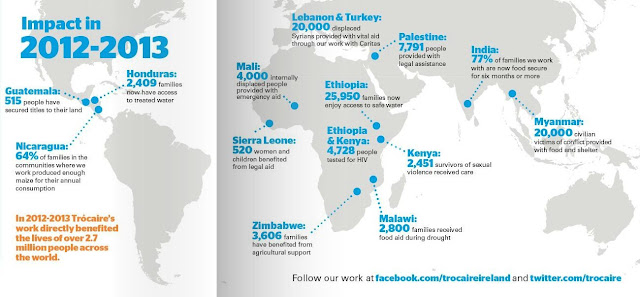
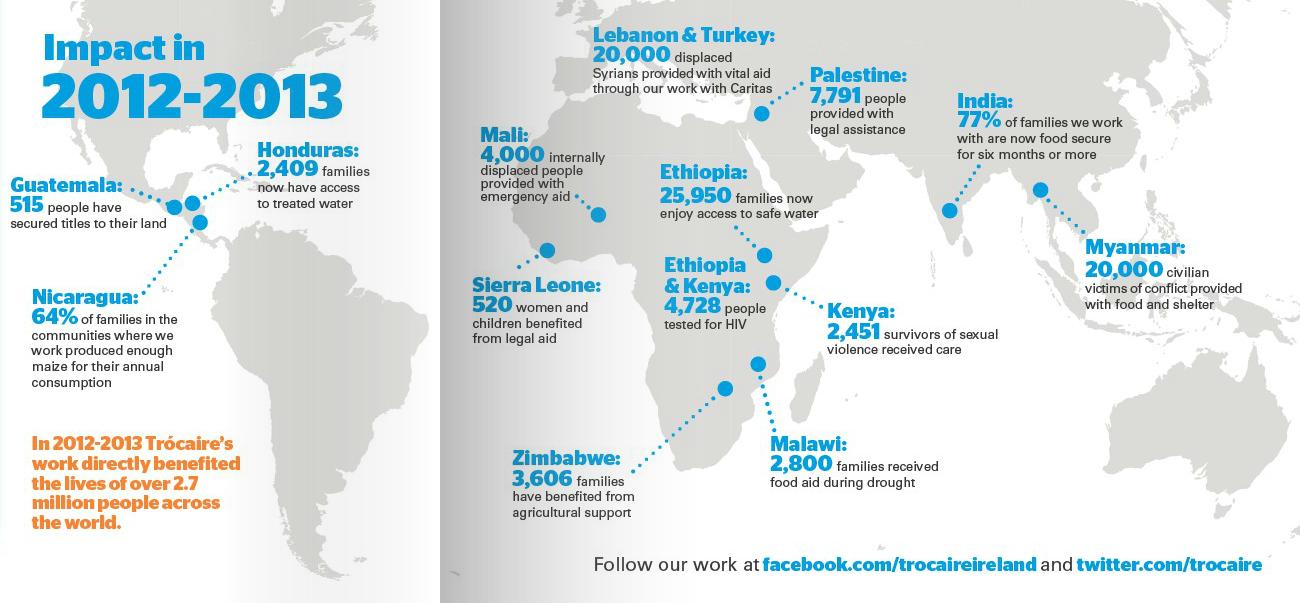
In their latest annual report they exclaimed that, because of their donors:
- 2,409 families in Honduras now have access to water.
- 4,000 people in Mali were provided with emergency aid.
- 20,000 victims of conflict were given food and shelter.
And much, much more.
The newspapers went with the headlines "Trocaire goes into red even after €1m donation", "Anonymous donor leaves Trocaire a bequest of €1 million" and "Over €4 million left to Trócaire in wills last year".
It's a shame...wasted, precious media space that could have been used to highlight successes or raise awareness of work still to do. What percentage of media space is wasted on celebrity gossip and wishful-scandal?
The majority of articles and comments focused on the CEO's salary. People asked how much of their donations go on salaries...despite the fact that the annual report answers this very question. Wouldn't we be better asking how many lives were saved for each donation?
It's our own fault...the media are pawns and fueled entirely by supply from the charity and demand from us - so that's clearly what we want to read. But just in case you'd like to read further than the headlines, here are some of the highlights I took from Trócaire's financial report:
Oh, and if you'd like to actually start discussing their impact and the incredible work they do, then why don't we focus on their achievements for a couple of seconds. Why don't we take a mild glance at their output before we even consider judging them?
Shouldn't that be the what annual reports are all about?
I wonder, what do the press releases look like?
Take Trócaire, for example...
In their latest annual report they exclaimed that, because of their donors:
- 2,409 families in Honduras now have access to water.
- 4,000 people in Mali were provided with emergency aid.
- 20,000 victims of conflict were given food and shelter.
And much, much more.
The newspapers went with the headlines "Trocaire goes into red even after €1m donation", "Anonymous donor leaves Trocaire a bequest of €1 million" and "Over €4 million left to Trócaire in wills last year".
It's a shame...wasted, precious media space that could have been used to highlight successes or raise awareness of work still to do. What percentage of media space is wasted on celebrity gossip and wishful-scandal?
The majority of articles and comments focused on the CEO's salary. People asked how much of their donations go on salaries...despite the fact that the annual report answers this very question. Wouldn't we be better asking how many lives were saved for each donation?
It's our own fault...the media are pawns and fueled entirely by supply from the charity and demand from us - so that's clearly what we want to read. But just in case you'd like to read further than the headlines, here are some of the highlights I took from Trócaire's financial report:
- Trócaire had a total income of €60 million and employed 423 staff. About 0.002% of their income went to their CEO, who worked for well below the market rate to manage a huge organisation and hundreds of staff and volunteers across 27 countries.
- None of their trustees or board received an income from their work with Trócaire. They didn't even claim any expenses - no mileage, no cups of coffee, no bus fare to get to board meetings!
It's worth noting that most private company directors would receive an income. It's safe to say these people have Trócaire's best interests at heart, and they are the ones that determined a fare salary for their CEO. If it was reasonable to pay less they probably would have. - Trócaire have published their senior manager's salaries - not many organisations, businesses or charities do that. Shouldn't we appreciate their transparency instead of criticising it?
- The income from the public stayed stable - it takes amazing supporters and an amazing fundraising team to achieve that in a recession.
- The level of detail is incredible. For example they specifically declared a €1,000 restricted donation from the Daughters of Charity. The people that benefit from their work is reported right down to the individual number. This is incredible for an organisation with a turnover of €60 million.
- But they put a pie chart in saying what percentage they spent on 'charitable' activity - I hate that...it's nonsense.
Oh, and if you'd like to actually start discussing their impact and the incredible work they do, then why don't we focus on their achievements for a couple of seconds. Why don't we take a mild glance at their output before we even consider judging them?
Shouldn't that be the what annual reports are all about?
How To Say No To A Street Fundraiser
I wanted to do a post on how to say no to a street fundraiser as so many people struggle with it, which I've never understood. The big secret is to say "No thanks" or "No" or nothing and keep walking on your usual path. That works 99.9% of the time.
If that doesn't work then you need to make a complaint...I'm going to do a post on 'How To Make A Complaint' as so many people seem to struggle with that too. (Hint: the first person you need to call is someone who can do something about it)
But I've also stolen a great idea from Diarmaid O'Sullivan and built upon it. So here's a voucher/coupon for you to complete and give to street fundraisers who try to engage you:

Thursday, August 15, 2013
I'm Sorry, But Charity Works
It is remarkably convenient to say that charity doesn't work.
That conclusion could save us billions in aid, allow each of us to personally save money in donations, and we could finally ban all those heartwrenching pictures we see on TV and in the post. Knowing that charity didn't work would allow us to feel helpless, remove all guilt and let us conveniently blame 'them'.
And a lot of people are telling us this.
Warren Buffett's son was the loudest most recently - he explained that "giving back" keeps the structure of inequality in place. "No charitable intervention can solve any of these problems."
And anecdotally you've probably read about a failed project, met someone who has seen a charity wasting money, or heard about a fat cat charity CEO sitting on a throne of gold human skulls. The latest charity CEO salary debate saw responses exclaiming that little or no money gets to the people that need it. That charities are not motivated to fix problems as it keeps them in employment. They're corrupt, they're inefficient, they're not transparent.
Yes, I'm sure you can find that charity (although most critics don't have any facts to back up their claims). I personally struggle with charities like the Iona Institute, those that promote homeopathy, and specific organisations I've seen managed badly.
But there are hundreds of thousands of charities who are making a difference. Charities who are transparent, will answer all your questions and will publish all of their achievements and failures. There is independent research and analysis showing projects and work that succeeds...that is working, and will continue to work as long as there is money coming in. Organisations like GiveWell are thoroughly researching charities and publishing exactly how well they are doing what they do.
And anecdotally try talking to someone who has seen the good work a charity has done or even benefitted directly from it. Try calling the Samaritans phone number or visiting an animal shelter and then saying it isn't "working". Look up how many people the Red Cross have trained in First Aid or how many wells Charity Water has built. Try talking to one of these fat cat CEOs or their staff and asking for the results.
But, as Stewart Lee said, you can prove anything with facts.
Of course they don't all work. In the same way that not all 'businesses' will succeed, not all 'politicians' are effective and not all 'scientists' are right. But you can't dismiss 'charity' because of another's failures. You wouldn't give up eating forever because you got food poisoning.
Unfortunately, it comes down to research and a little bit of trust. Research in the same way you would research the creche you leave your kids at or research a car before you buy one. And trust in the same way you have to trust that not everyone on your flight is a terrorist and not everything is a scam.
The Effective Altruism movement is the desire to make the world as good a place as it can be; the use of evidence and reason to find out how to do so; and the audacity to actually try.
Massive inequality, unethical companies and immoral governments and laws are making it more difficult to have an impact (and of course that needs to change). But that's no excuse to give up improving lives within the constraints we have.
There's no easy way to say this. You can make a difference and change the world.
But it's going to take a little work.
That conclusion could save us billions in aid, allow each of us to personally save money in donations, and we could finally ban all those heartwrenching pictures we see on TV and in the post. Knowing that charity didn't work would allow us to feel helpless, remove all guilt and let us conveniently blame 'them'.
And a lot of people are telling us this.
Warren Buffett's son was the loudest most recently - he explained that "giving back" keeps the structure of inequality in place. "No charitable intervention can solve any of these problems."
And anecdotally you've probably read about a failed project, met someone who has seen a charity wasting money, or heard about a fat cat charity CEO sitting on a throne of gold human skulls. The latest charity CEO salary debate saw responses exclaiming that little or no money gets to the people that need it. That charities are not motivated to fix problems as it keeps them in employment. They're corrupt, they're inefficient, they're not transparent.
Yes, I'm sure you can find that charity (although most critics don't have any facts to back up their claims). I personally struggle with charities like the Iona Institute, those that promote homeopathy, and specific organisations I've seen managed badly.
But there are hundreds of thousands of charities who are making a difference. Charities who are transparent, will answer all your questions and will publish all of their achievements and failures. There is independent research and analysis showing projects and work that succeeds...that is working, and will continue to work as long as there is money coming in. Organisations like GiveWell are thoroughly researching charities and publishing exactly how well they are doing what they do.
And anecdotally try talking to someone who has seen the good work a charity has done or even benefitted directly from it. Try calling the Samaritans phone number or visiting an animal shelter and then saying it isn't "working". Look up how many people the Red Cross have trained in First Aid or how many wells Charity Water has built. Try talking to one of these fat cat CEOs or their staff and asking for the results.
But, as Stewart Lee said, you can prove anything with facts.
Of course they don't all work. In the same way that not all 'businesses' will succeed, not all 'politicians' are effective and not all 'scientists' are right. But you can't dismiss 'charity' because of another's failures. You wouldn't give up eating forever because you got food poisoning.
Unfortunately, it comes down to research and a little bit of trust. Research in the same way you would research the creche you leave your kids at or research a car before you buy one. And trust in the same way you have to trust that not everyone on your flight is a terrorist and not everything is a scam.
The Effective Altruism movement is the desire to make the world as good a place as it can be; the use of evidence and reason to find out how to do so; and the audacity to actually try.
Massive inequality, unethical companies and immoral governments and laws are making it more difficult to have an impact (and of course that needs to change). But that's no excuse to give up improving lives within the constraints we have.
There's no easy way to say this. You can make a difference and change the world.
But it's going to take a little work.
Subscribe to:
Posts (Atom)